
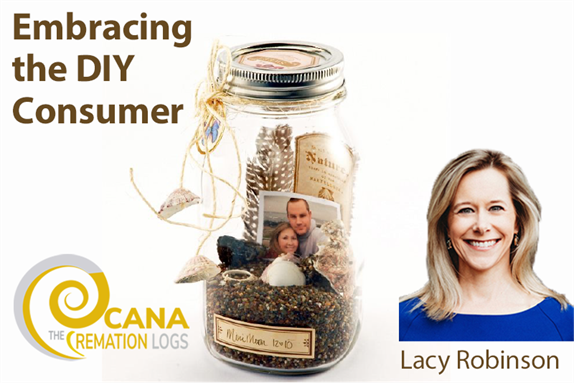
 When the US economic crisis of 2008, forced individuals and families to become more budget-conscious. As a result, people got resourceful and creativity flourished, especially when it came to memorializing loved ones. In some cases, this meant the funeral director was cut out of the equation entirely or left on the outside looking in. I don't think it has to be that way. You can reposition your role and partner with these DIY people, these family members that want to work behind the scenes and bring additional value to their life tribute event. what do we know about the diy consumer?I want you to think about the family members that you've sat across from who are the DIY consumer. I want you to think about yourself and your friends and family who have the DIY bug and think about the feeling when you complete a DIY project. It is that sense of satisfaction. It is happiness that you feel. The new Man Cave is the She Shed! It's where the DIY consumer gets the solitude, the focus, and the space to complete these projects. These projects that are an instant mood enhancer for them. And that's how these family members feel. This isn't just something that they do on a whim. And the most famous DIY-ers? Martha Stewart has been around for decades. Chip and Joanna Gaines started with one home decor store and now they have their own television network. Ben and Erin Napier and the Property Brothers are part of the HGTV Family. Brit Morin is known as the digital Martha Stewart, and Tommy Walsh is one of the most well-known international DIY personalities. And now, because of YouTube, Instagram, and TikTok, we've seen the explosion of DIY bloggers all over the world. Some bloggers have their own sites or they use social media sites to reach out to potential DIY-ers. And it is their eagerness to provide video tutorials – step-by-step guides – to invite and encourage people to be a part of the DIY world. It is evident that the DIY world is expanding and here to stay. Data shows that 50% of DIY consumers are female and 52% are between the ages of 24 and 44 – a mix of Gen X and Millennials. We know that DIY projects are directly tied to life changing events: a graduation, an engagement, getting married, having a baby, buying a home, and, we can add, the death of a family member. Every time there's a milestone or something big happening in their family, they have an event. They bring people together. They honor old family traditions. They start their new traditions, and it's not just about their immediate family, but they bring in their extended family and they also reach out to their large social circle of friends to be a part of those special moments. And, because of that, a life tribute event will most likely be the topic of conversation among many of the attendees. It will be the word-of-mouth marketing that funeral homes want! But—guess what? That funeral director will fade into the background and simply be seen as the person who provided the place and took care of the disposition. HOW CAN YOU COLLABORATE WITH THE DIY CONSUMER?Here are three ways to partner with those individuals to help you and your entire team avoid getting left out of the conversation when a DIY consumer appears in that arrangement conference. SPEAK TO YOUR CREDIBILITY The words “licensed funeral director” carried a lot of weight for many, many years. Then, we needed to say “licensed funeral director and cremation specialist.” Now we need to add a third line of credibility, and that is your “creative” credibility. That DIY consumer needs to hear, in the very beginning of that arrangement conference, that you are creative, that you're willing to explore ideas, and that you have resources to execute their vision. BE THE IDEA GENERATOR What I hear most from funeral directors is that they don't have the extra budget or the extra time to do the “wow” factor for a family. I understand that, so think of yourself as an idea generator instead. It builds your credibility. It says: We are creative. We want to help you. For example, "it was interesting to hear about your sister's involvement with Dolly Parton’s Imagination Library. I was thinking of a few different ways we could honor that part of her life." KEEP RESOURCES HANDY Have websites, magazines, and books available for your funeral directors to enable them as idea generators. Know the websites that consumers are going to directly. These are three from my extensive list of websites: beau-coup.com is a wedding and baby shower website (I forewarn you), but they have every possible keepsake, covering all different hobbies and interests, and can be personalized with shipping options to ensure items arrive in time for a tribute. stylemepretty.com collects wedding ideas from all over the world to find out what brides are doing, what the trends are, and what resources that they're utilizing. If I was looking for tropical - Hindu - Jewish funeral ideas, I could go to Style Me Pretty to get some inspiration. And that's what you're going to find: a combination of cultures, hobbies and interests that bring it all together. And it's not just pictures: it is the resources and the vendors, too. pinterest.com is ideal for free consumer research. Hop on and type in the search box “my funeral” or “mom's funeral” or “dad's funeral” and look at all the Pinterest boards that have those names. And these are just the public-facing samples! These are the ideas that people are collecting, that they're thinking about, so when the time comes, they go to their Pinterest board and see what they've collected over the past couple of years for a loved one or for themselves. remembering well"When families participate, they remember. When they remember, they grieve. And when they grieve, they love." Remembering Well, by Sarah York That's the impact that you can have on these family members who want to have those DIY moments with other family members behind the scenes before that tribute takes place. This post was excerpted from Lacy Robinson’s presentation of the same name at CANA’s 2022 Cremation Symposium. Want to learn more about the DIY Consumer and get more ideas from Lacy? You’ll have to catch her presentation yourself!
 Below is a sneak peek at the keynote presentation for CANA’s 2022 Cremation Symposium, titled Storytelling for Funeral Service. If you haven’t secured your attendance, you can register here WHAT DO WE MEAN BY “STORYTELLING”?Storytelling as a marketing tactic has been buzzing around the industry for a couple of decades—especially since the Internet, and its ability to reach more people more often, became ubiquitous. But when asked to define storytelling, marketers often hem and haw. They hail it as the Next Big Thing in Business Development, but then fall back on cliches and misunderstandings. They mistake “branding” or “customer experience” for storytelling. So let’s define our term right off the bat: storytelling, noun using narrative techniques—i.e., this thing happened, then this next thing happened, then the next thing happened, etc.—to connect with your audience, shape their impression of your business, and demonstrate your purpose. If examples of good brand storytelling might help you understand the concept, check out this example by Google or this one by Apple or this one by Dove. WHY STORYTELLING MATTERS TO YOUR BUSINESSWe could fill a book describing the benefits of brand storytelling. Among the chapter titles in that hypothetical book:“Storytelling is as Old as Homo Sapiens”
“Stories are ordering, sense-making machines, helping our brains to render the frantic incoherence of chaotic existence into comprehensible narratives.” Stories help us make sense of a world that is often confusing, isolating, enormous, and filled with contradictions. For funeral professionals, stories’ ability to organize our many feelings and thoughts is especially powerful, and that’s because. . . emotion produces actionNearly all human behavior is driven by emotions. When we feel something, we respond—sometimes consciously, often not. When a potential customer approaches your funeral home, they are in a heightened state of emotion. They’re either planning a funeral for a loved one (feeling grief) or pre-planning their own funeral (feeling nervous or sad). A great story can help them sort out—even if just to a small extent—the wild mix of feelings they’re dealing with. The alternative is far less effective. . . making claimsThe opposite of storytelling is “making claims.” This is what most businesses do:
Put more simply: If you want to persuade someone to do something, such as hire you to conduct a funeral, you want them feeling, not thinking. 8 seconds to ejectionIn 2000, a global study suggested that the average human attention span is 12 seconds—i.e., we devote 12 seconds of conscious focus on a new piece of data until our minds move on to the next thing. In 2013, another study reported that our attention spans had plummeted to eight seconds. Twelve to eight seconds in just over a decade—what could account for that? You know, of course: the explosion of Internet technology, computers in our pockets, Instagram, lightning-fast broadband connections—all of it. Never in the history of our species have we had so little time to try and communicate so much. But there’s good news. While you have very little time to connect with strangers, you have:
FIVE QUICK STORYTELLING FUNDAMENTALSOnce you have their interest, it’s time to tell your story. Here are some cornerstones of brand storytelling. We’ll discuss some of these in more detail at the CANA Symposium, but here’s an advance look.
 Andrew shares the stage with presentations from experts across the profession:
 As 2022 begins, there continue to be evolving demands competing for your time and energy. The last two years have seen some significant changes and developments in many areas of the industry and the laws which govern it. As with the beginning of every new year, it remains important to refresh and improve our habits. It is not too late to resolve to accomplish the following risk management and legal checklist items and establish a new routine for years to come. 1. UPDATE AND REVIEW CURRENT GOVERNING LAWS AND REGULATIONS. Regardless of your role in the industry, it is important to understand the current laws and regulations that govern your work. The COVID-19 pandemic has led to the implementation of many new laws and regulations which may impact your business. Put aside the necessary time to review the federal, state, and local laws and regulations which affect your daily operations. While right to control final disposition and cremation authorization issues continue to dominate legal complaints against people and businesses in this industry, there have been many new developments in the area of labor and employment, employee safety, and non-discrimination laws which may impact your business. If you have difficulty finding the statutes and regulations governing you and your business, try searching the web sites for your state association or licensing board – they often have links available. Federal OSHA and EEOC web sites, and their state counterparts, also provide significant information and updates. 2. EDUCATE AND TRAIN STAFF ON ANY NEW LAWS OR REGULATIONS AFFECTING YOUR BUSINESS. Keeping yourself updated on new laws or regulations is just a first step. The next is to educate and train your staff and co-workers on what you have learned. Hold a “lunch and learn” with your team and give everyone the tools to succeed. Education and training are vital steps to every risk management and compliance program. 3. UPDATE YOUR FORMS TO BRING THEM INTO COMPLIANCE WITH ANY LAW CHANGES. Out of date, non-compliant forms are an easy target for regulators and plaintiffs’ attorneys alike. Confirm that your form documents include all the required notices, consents, and disclosures. Consult with an attorney if you have any questions regarding current legal requirements. 4. EDUCATE AND TRAIN STAFF ON THE CHANGES IN YOUR FORMS. Compliant forms are important, but the persons who use them every day must understand how to utilize them to the fullest. Avoid the problems caused by improperly filled out forms. If done and utilized correctly, forms often provide the best documentation in defense of legal complaints. 5. REVIEW AND UPDATE YOUR OPERATIONAL POLICIES AND PROCEDURES. Regulatory compliance is critical to a successful operation. So, too, are human resource policies, and so much more. If you need assistance in your review, CANA has partnered with Cremation Strategies & Consulting to offer a program which will help you compile operational policies and procedures customized for your business. 6. REVIEW AND UPDATE YOUR EMPLOYEE HANDBOOK (INCLUDING SOCIAL MEDIA POLICY). Employment issues are a prevalent headache across all industries and business models. Address common concerns in your employee handbook, so that everyone is on notice of the standards to which they will be held accountable, including:
7. EDUCATE AND TRAIN STAFF ON YOUR POLICIES AND PROCEDURES. Periodic training and review of operational and employment policies and procedures are critical. There cannot be compliance without your employees first understanding your expectations and standards to which they will be held accountable. 8. MEET WITH YOUR INSURANCE AGENT OR BROKER. Make sure your insurance agent or broker understands your business. Make time for these critical discussions. Do not assume that your insurance agent or broker “just knows” because he or she has worked with you in the past. Too often there are gaps in coverage discovered when you need insurance assistance or defense to a legal claim, when it is too late to put the protections you need in place. Many gaps in coverage result from your agent or broker not understanding your daily work and operations sufficiently to make sure that what you actually do is covered. Just because you have “professional liability” insurance, you have no guarantee that all of your professional services are covered. Proactive insurance strategies will serve you best. 9. MEET WITH YOUR TAX PLANNING PROFESSIONAL. Do not leave money on the table. A tax professional’s advice can add value to your business and improve its bottom line. Mitigate your tax risks and exposures prudently. 10. BUDGET FOR AND PLAN TO ATTEND MEANINGFUL CONTINUING EDUCATION OPPORTUNITIES. Take some time to think about the education and assistance which will benefit you and your business most in the upcoming year. Then, search for continuing education opportunities that will assist in meeting your goals. There are in person and online resources available to address almost any concern as an industry professional or business owner. Some jurisdictions even allow you to get your crematory operator certification online. While this might be challenging as we all face the realities of a continuing pandemic, it is important to find those educational opportunities that will provide the insight and knowledge you need for success now and in the future. Getting your new year off to a good start can jumpstart accomplishing your business’s New Year’s resolutions. Best wishes for your success in 2022! CANA Members: Your association is here to help! If you ever need these resources or anything else offered by CANA, reach out.
 More than 90 percent of online experiences for consumers start with a search engine. Whether these consumers tap on their phone to query Siri or type a key phrase into Google's browser bar, the result is the same for your deathcare firm. If you're not drawing a clear line between search engine results pages and your own website or offers, you're missing out on revenue opportunities. This is one reason content is king—and has been for years. But it's no longer enough for content to don a crown and hold court over your marketing strategy. The king has lots of competition for search engine optimization, and if neighboring kingdoms (aka your competitors, if you're still humoring this extended metaphor) are generating better quality content, your SEO performance could suffer. And by "suffer," I mean your pages won't show up at the top of the search results—or potentially at all. Which means you have less of a chance of connecting with people who might be interested in cremation and related services now or in the future. What's a king to do about this conundrum? Luckily, Google itself publishes a battle plan that helps you create high-quality content that's more likely to perform in Search Engine Results Pages or SERPs. It's called the Search Quality Evaluator Guidelines. WHAT ARE SEARCH QUALITY EVALUATOR GUIDELINES?Google publishes these guidelines for its human search quality evaluators. Actual humans (yes, that's rare these days) review pages to determine whether they meet the needs of a potential search in a high-quality manner. The higher a page is rated by evaluators, the higher it might potentially rank in search results. Evaluator scores aren't the only thing used to rank a page—Google algorithms are complex, after all. But the evaluator guidelines do provide important clues into exactly what Google considers important when it comes to content PAIRING GOOGLE GUIDELINES DOWN TO A SUCCESSFUL CONTENT FORMULAThe guidelines comprise roughly 170 pages of small text, which is obviously a lot of information to get through. But you don't have to read everything in the evaluator guidelines to understand how to create great cremation services content. Consider this quick formula for high-quality content from Google: Purpose + E-A-T = Quality PAGES MUST HAVE A PURPOSE High-quality content serves the purpose of the page. If your page doesn't have a purpose (which might be to inform, entertain, or assist readers), the content can't be high quality. Or as Google puts it, pages "created with no attempt to help users, or pages that potentially spread hate, cause harm, or misinform or deceive users, should receive the lowest [quality] rating." REMEMBER THE E-A-T ACRONYM When pages do have a positive purpose, Google rates the quality of their content according to "E-A-T." The acronym stands for expertise, authority, and trustworthiness. Per Google, E-A-T content…
WHAT ELSE DOES GOOGLE SAY ABOUT HIGH-QUALITY CONTENT?Google likes the word satisfy. It appears in the evaluator guidelines more than 130 times in various forms. A high-quality page satisfies the needs of the searcher and the promise you made in meta descriptions and headings. If you promise a complete guide to preplanning, your content should certainly be more than 500 words and cover all the questions someone has about that topic. If your link is a buy link for an urn, the page should include everything a person needs to make a final purchasing decision. The shopping cart process and customer service options should also satisfactorily meet the needs of your cremation clientele. Ultimately, Google's SERPs have one job, and that's to match searchers with pages that best meet their needs. By creating high-quality content that follows the above formula, you increase the chances that Google thinks your page is a good bet for the relevant keyword searches. In turn, that increases your chances at winning the click, driving more traffic, making more sales, and proactively competing with the other kingdoms in your niche.
 “2020 was like looking both ways to cross the street and getting hit by a plane.” That is my favorite joke describing 2020. It’s funny because it’s true. The pandemic spread of COVID-19 came out of nowhere and changed everything and everyone. Our best intentions, planning and hard work could not have prepared us for the challenges of a triple pandemic – disease, social turmoil, and political unrest. When faced with uncertainty and continuous change, I have been amazed by how quickly and well CANA members have adapted, particularly in responding to trends that were impacting funeral service before the pandemic and will continue to be important in the year to come. Reflecting on 2020, it seems clear that death care workers returned to fundamentals to find solutions for dealing with such cataclysmic change. Now, as we start 2021, we can take a moment to set goals and priorities to meet the challenges to come. CANA cohosted a webinar in 2020 with DISRUPT Media during which we asked industry experts to comment on key trends. Some of those pearls of wisdom are included throughout this post. rising cremation ratesCremation rates have been rising steadily and predictably at an average of 1.5% nationally for the past decade. That predictability has now come to an end. All of the reasons people chose cremation before, remain true: price, convenience, possession, seeking new traditions. Those reasons plus more than 300,000 excess deaths in the United States alone have resulted in a jump in cremation numbers and rates. “So we’re getting a taste of what that’s going to look like in our industry. And for the next 20 years, you’ve got this spike in crude death rate, then you also have an acute rise in cremation rate that’s going to take place during the same time. You also have a decrease in religiosity and the value of service… as an increase in Nones and a decrease in overall people who claim Christianity. So, how does that impact service and how does that impact your margin? If we’re not making sure that we build value and we build relationships and we build a service offering around a model that really speaks to the consumers’ needs and wants, then we’ll find ourselves not really being funeral service providers anymore, but being more like just disposition order takers. It’s going to be scary.” – Rahsaan Brown As cremation rates have become the majority of dispositions, funeral homes and cemeteries have struggled to offer new, personalized services that demonstrate value to the cremation customer. Funeral professionals bemoan the DCRTF (direct cremation, return to family) phenomenon, but too often aren’t engaging with families to see what they would value or assistance or expertise that would be helpful. This trend has increased during the pandemic, not just because of consumer choice, but also because of safety concerns around gatherings. “Most funeral homes just went through an increase in volume. Not necessarily profit, but in volume. Anytime you have an increase, what comes after? We could have some days that could be less than what you had expected. So now is the time, when you’re catching your breath, to train your staff, to redo your general price list, to get your overheads in line. Train, get prepared, because it’s an ongoing battle. There may be some days that are light and some days that are heavy, but the bottom line—it doesn’t stop. I think the well-prepared funeral homes are taking in all the things [we’ve learned] to be strong so that they can meet the future needs.” – Jeff Harbeson The trends we watched pre-pandemic are more impactful than ever. What is the path forward? I encourage you to make 2021 the year to shore up your foundations to position your company for success. technologyAs recently as February 2020 (at the CANA Cremation Symposium) we were discussing incremental change to serve families. We had no way of knowing that days later the world would turn upside down. Seemingly overnight, funeral directors pivoted to offer livestreamed services, online and phone arrangements, and new strategies to manage staff and operations remotely. Many of these early activities were conducted with no more sophisticated equipment than smart phones. We have come a long way since then, or have we? This is the year to upgrade your technology game. Everything from arrangements to funerals to continuing education will continue to be offered online. Invest in stable, fast internet and computers with web cameras sooner rather than later. Software advances can help with everything from case management to first calls and staff coordination. Grow your online offerings to meet the consumer where they are. “We’ve got to continue to provide ways for the consumer to connect with funeral homes on their own terms and in their own way. That’s something that, as a profession, historically we’ve not been great at. There’s been one way for consumers to connect with funeral homes and cemeteries and cremation companies: we’ve relied on people just walking through the door as a way to grow market share and serve a consumer that now is more remote than ever. 80% of funeral home business is relationship-driven. From a marketing perspective, that relationship conversation has to be a focus of the marketing to continue to build those relationships and make that line of communication even more open.” – Ryan Thogmartin Technology will remain the key to brand awareness and marketing success as well. But beware that you will sell what you market. If you are promoting low-cost, minimal service cremations online and via social media, that is what they’ll buy. Now is the time to use these platforms to educate your communities about the services you can (safely) offer with the help of technology and your facilities. Also, amplify local news on your social media channels. Facebook is the host for most local news and outlets and governments. Even in large cities, neighborhoods will have Facebook pages. We are spending more time online during the pandemic than ever before, and good news stands out. Let your feed be the bright spot as well as source for obituaries and practical tips. You offer solutions to problems that death-averse consumers weren’t willing to discuss or plan for nine months ago. Preneed sales have increased during the pandemic, but have you effectively communicated your ability to help them discuss and make plans? Your creativity and problem-solving are your best assets, and your communities need you now more than ever. “We have said all along that a lot of those immediate disposition families that walk out of the door with their urn in their hand are doing so because they’ve seen our product and it sucks and they know it and they’re not going to pay for something that doesn’t speak to them. And so, as we adapt to the growing number of Nones—they are now the largest group; they are at 26%, above Catholics and Protestants. They’re not going to go away. They’re going to continue to grow. As we look at those families who, just like you, are looking for something different and unique, we have got to find those skills or those people… Part of our job right now is bringing people back. Those people who had to have a very minimal service because of lock down, inviting them to come back and inviting them to have a creative experience after the fact. Don’t sit and wait for the phone to ring. They’re not going to call and say, ‘Hey, I’m ready to have a funeral.’ You’re going to have to reach out to them and say, ‘Now, are you ready to have a chance to honor your mom that you didn’t get to do?’” – Glenda Stansbury When my grandmother died in March and we had a livestreamed graveside and Zoom celebration of her life, we discussed gathering over the summer to have a family reunion in her honor. Needless to say that didn’t happen, and we aren’t going to gather this year or probably ever for that purpose. I gave the funeral home a 5-star review on Google, however they returned thousands of dollars of preneed funds earmarked for the funeral to the estate. How many families have you served in a similar situation? How many have come back to do that delayed service? Or did they simply make do? Have we accelerated the trend toward cremation without services by funeral professionals? Only time will tell. Human beings are strange creatures – we crave what we can’t have – so it is quite possible that when funerals are permitted, there will be an increase. In the meantime, many CANA members have offered community-based memorial services. Some these are purely virtual, some are a hybrid of small in-person gathering with livecasting. I watched several in November and December and each acknowledged that we are grieving more than the loss of loved ones. That was a welcome and comforting message. setting prioritiesThe stats on people accomplishing New Year’s resolutions is depressingly low, however goal setting is still valuable and really the best way to track success. We see gaps in service and opportunities for improvement during our busy times, precisely when there is no time to tackle a new project. So write your ideas down and keep track of them. A break will come and that is the perfect time to set your priorities for new projects or improved procedures. Did you always mean to start an aftercare program? Get on it! Still not sure how to understand all of the financial data and business metrics? Set up a meeting with your accountant or take a class. Still not sure what social media can do for your business? Ask for help and try a campaign. Make relevant continuing education a priority for all of your staff and yourself. Set goals and measure progress toward them. Then celebrate your successes. This is the best way to focus on the important and not just the urgent. “I truly believe that the message for all of us in the profession is that old song: ‘You don’t know what you got ‘til it’s gone.’ To me, that’s one of the most inspiring things and something I’m going to take forward... I think it’s important for us to look at it as we’re leading the consumer. You have to meet them where they are, but all of us as a profession need to look just a little far ahead of them so that we can be there when they get there. That’s something I think we missed with the ‘increase in preference for cremation as disposition.’ We did not look ahead enough and we didn’t pay attention to the trends so that when that consumer came in and said, ‘This is what I want,’ we were prepared to help them on their terms. So those are the takeaways that I took today and hopefully others can think about and use to improve their businesses.” – Dean Lambert staffingConventional wisdom has long said that 50% of funeral directors leave the profession before their fifth anniversary. Emerging research coming this year from the American Board of Funeral Service Education (ABFSE) has disputed that number and findings show it’s lower, closer to 30%. Either way you look at it, funeral directors are struggling with long hours, low wages and difficult work. Your people are your most important asset, including yourself. You were likely busier than ever in 2020 with deaths predicted to be as much as 20% more than 2019. That is a lot of cases to handle with families to serve while you work within changing restrictions. What are you doing to promote resilience for your team? Is mental health, depression and burnout a topic of discussion? “You talk about margin, you talk about impact, you know, we’re talking about a crude death rate and all this stuff from the external customer’s perspective. But what about the internal customer? Have you taken care of your staff and created protective policies to ensure their good health?... We’ve got to put those policies in place and make sure that our people are okay, because what is the financial impact to losing a funeral director because they got burned out? How does that impact margin? How does that impact your overall business to have to now go and recruit? It’s already pretty scarce, to find licensed professionals that are competent and that you can feel confident in. What happens when you lose someone because of COVID? “The other flip side of it is, as business owners and funeral home owners, we have to also take care of ourselves. I look at all the owners and founders and CEOs and business professionals that are over the age of 55 that are having burnout issues and checking out. That’s another customer that we’ve got to spend some time focusing on. As we see more cases, we can make some adjustments to the value offering and we can stay profitable—but we have to be here. We have to survive and we have to make sure that our team, our staff, survives and thrives during this time to be able to implement those adaptations and evolutions to the model.” – Rahsaan Brown Now, we’re facing a new calendar year, but this real-time, continuous risk management experiment that we are living has not gone away. Hopefully, we will soon have new tools to combat the disease, like easier access to PPE and vaccines, and also to support ourselves and each other. We have learned to safely serve our communities through deadly viruses before, and COVID-19, too, will likely remain with us. PPE works, and – with continued engagement and creativity – we will find the tools to serve our communities and navigate 2021. My thoughts are with you during the next phase of this continuing crisis. On behalf of the staff and leadership of the Cremation Association of North America, happy new year. This post excerpted from the “What’s Ahead for Funeral Service” cover story in the January 2021 issue of American Funeral Director published by Kates-Boylston and comments from industry experts during the WTF?: What’s the Future of Funerals webinar on October 14, 2020. You can watch the complete recording of this webinar and many others on-demand on CANA’s website: goCANA.org/webinars. CANA Members, we featured the highlights from this webinar in Volume 56, Issue 4 of The Cremationist – you can read the full issue on our website with your member credentials. Not a member yet? See the other benefits of CANA Membership here.
WEBINAR EXCERPTS FROM NOTABLE INDUSTRY EXPERTS:
Rahsaan Brown is CEO and owner of Blue Nebula Consulting, a nationally scaled organization that focuses on assisting funeral homes build their sales and marketing departments. Jeff Harbeson, a.k.a. the Funeral Commander, is the Director of Cash Flow Solutions at C&J Financial, where his specialty is producing accounts receivables and increasing cash flow. He is a former funeral home owner. Ryan Thogmartin of DISRUPT Media is CEO of ConnectingDirectors.com, Price My Funeral, and Death Care Jobs, as well as the Funeral Nation co-host, along with Jeff Harbeson. Glenda Stansbury is the vice president of InsightBooks, a publisher of books on grief and aftercare. She is also a licensed funeral director and embalmer. She is the co-founder and the trainer for certified celebrant training. Dean Lambert is the Marketing Communications Officer for Homesteaders Life Company and has been with them for a little over 22 years. He’s worked with funeral homes to help with marketing, communications, and promotions since 1991, so he’s approaching his 30th year with the profession.  CANA’s website caters to both the profession looking for resources and the general public learning about cremation services. Satisfying both groups’ interests, the Transporting Cremated Remains page consistently ranks among most visited of CANA’s website. Staff frequently get calls for advice on carrying and shipping cremated remains domestically and internationally. Yet too often, we see articles about cremated remains mishandled or lost with families desperate to find their loved one. Unfortunately, transporting the dead can be complicated, with different rules for every mode of transport, for every origin and destination, all of which is further clouded by a general lack of awareness about the funeral profession and the work we can do. diplomacy for deathAt Fairfax Memorial Funeral Home and Crematory, CANA’s President-Elect Archer Harmon has the staff and experience to help get the dead where they need to go. Being so close to Washington D.C., Fairfax Memorial is frequently called on to help families all over the world. Archer has addressed members of the College of Consulates, a group of international consular staff, on procedures for transporting the dead. These attendees are seasoned professionals for whom the United States posting was not their first. They had extensive education and training for this posting, but to the one, they were surprised and unprepared to handle the variety of inquiries regarding repatriating casketed or cremated remains to their respective countries. In several cases, Archer has actually helped the consulate repatriate a citizen when the staff were uncertain on how to proceed. The laws and regulations exist, but death is fraught with cultural interpretations and misunderstandings. For most countries, cremated remains are subject to the same guidelines that apply to a casketed body. The paperwork is extensive and may include some, or all, of the following:
The above items may need to be translated to the destination country’s native language, notarized for official use, or more. specialized service Understandably, this is a complicated process, made more difficult if a business isn't near the nation's capital or doesn’t have a staff with experience in this work. CANA estimates that only a handful of funeral homes, cemeteries, or crematories in the US handle repatriation alone. Families without professional expertise are at a greater disadvantage without the experience and network to get their loved one safely on their way. This difficulty is why CANA gets so many phone calls, and our first step is to refer to reference books like the Redbook. We also reiterate the same guidelines we provide on our webpage: ship to a funeral home, not a private residence; contact the consulate/embassy first; get duplicates of all paperwork; carry rather than ship when possible; etcetera, etcetera. Even then, one CANA faculty member used to warn, too often you can expect your international postal shipment of cremated remains to be returned to the sender. We recommend reaching out to the professionals who have dedicated staff monitoring the many variables of transportation and shipping, who are experienced in this work, and come with an international network to help. Shipping via an agent or air cargo may be more expensive, but well worth the peace of mind. CANA Members that specialize in transporting remains offered these valuable insights:
pandemic shippingOf course, this complicated process is further challenged by a pandemic: travel restrictions between countries, canceled flights, closed offices, and more. Here's what CANA Members say: Inman Shipping: Travel restrictions and embargos during the pandemic are significantly impacting shipping and transporting remains. Inman works closely with our sister company, Eagle’s Wings Air receiving hourly updates as airlines continue to delay and cancel flights. Inman constantly monitors all of these factors and provide up-to-date information to the receiving funeral home. Due to the pandemic, many airlines have significantly reduced their flight schedules. We advise to not set services until the remains have arrived at your funeral home. We are also asking for your patience while waiting to receive permits and death certificates. Many of our funeral homes are located in cities with lockdowns and have local health departments which may be currently closed. Additionally, due to airlines needing to furlough both reservation and cargo staff, certain airlines are unable to book flights during the weekend. Unfortunately, certain airlines will not allow COVID-positive remains to ship internationally. We continue to work closely with the airlines to monitor what is available to our customers. MacKinnon & Bowes: The pandemic has provided some new realities that must be taken into account for shipping bodies or cremated remains.
National Mortuary Shipping (NMS): For the most part it is getting much easier to ship and transport human remains then it was at the beginning of the pandemic. Airlines are starting to have more flights and loosen up their restrictions some. However, there may still be time delays because even though the airlines are regaining traffic there may be less available flights and some cargo stations are still closed. Some International destinations are not always available and often very delayed. seasonal rushAnd even when everything settles into a new normal, don't forget that the seasons will still change, and the weather with it. In the same way you plan your travel and gift shipments, advise families that they will need to plan well ahead, and delay making plans until remains safely arrive. CANA Members suggest: Inman Shipping: Winter weather issues, post office delays, and seasonal holidays can cause delays in shipping and mailing of cremated remains. With the dramatic decline in available flights and only cargo space for two human remains onboard a flight, it is necessary to set proper expectations for family members awaiting the return of their loved one. While families may wish to proceed with quickly setting services, it is very important that services are not arranged until body has been received into the care of the local funeral home. Most cremated remains are returned home via the US Post Office, which has also caused unexpected delays due to slower Post Office service. MacKinnon & Bowes: Winter months in northern US and Canada represent challenges for delayed and cancelled flights due to weather. Even flights from the south could be impacted by interruptions caused by delays in the overall system and aircraft that does not arrive at the point of departure in time for scheduled departures and connections. Holidays represent times when most Airlines provide diminished service capabilities. Advance planning and anticipated potential for disruption should always be taken into account when forecasting arrivals, services, and dispositions. National Mortuary Shipping (NMS): It is important that everyone understands that time can be a sensitive issue when shipping. There are times that doctors and health departments as well as distance may create delays in shipping. Another factor is the hours and location of airline cargo facilities as well as delays caused by weather and other circumstances. These may be unavoidable and create unanticipated delays in shipping. We know it is difficult when a family requests services be set for a specific day; however, we always recommend because of these potential delays to try to avoid deciding for services until the deceased has arrived at his or her location. Like seasons, political situations also change with countries falling in and out of favor with one another. This can impact the ability to cross borders, even for the dead. As an example, when shipping to Cuba from the US was limited, Canada often provided a necessary layover where Canadian companies could take possession and arrange the final leg of the journey. something to write home aboutAs CANA's founder, Dr. Hugo Erichsen, said, "Cremation is preparation for memorialization." This idea is also immortalized in CANA's Code of Cremation Practice. When discussing plans for permanent, dignified placement of cremated remains abroad, it is important to plan ahead and allow time for arrangements to be finalized. That way, everyone gets the homegoing they deserve, surrounded by the people that loved them. CONTACT THE EXPERTS For more from CANA’s member experts in shipping and transportation: Inman Shipping Worldwide is the oldest and largest repatriation company in the country. We are the experts in returning a loved one home for ceremony. We address the needs of an increasingly mobile society. As careers and retirement take us to all corners of the country and even the world, Inman addresses the need to return the remains of a deceased loved one home for ceremony. Inman coordinates the transport of the deceased from any part of the world to their final resting place. We oversee the entire process, regardless of the distance involved, so that the sensitivities of the survivors are fully protected. At Inman Shipping we provide round the clock support to our customers. Our team of professionals are available any time of the day or night to begin a new domestic or international shipment, or answer a question related to a shipment. Our website, www.shipinman.com, is also available to request a quote for transportation or start a new shipment. We can assist your funeral home with an out of town direct cremation as well as full body repatriation. MacKinnon & Bowes Limited is an assistance firm that provides support services to funeral providers, crematoriums and cemeteries for a wide array of services including flight bookings, shipments, cremations and repatriations from countries all over the world. MacKinnon & Bowes is a family owned funeral service company staffed by licensed funeral directors and has been a proud CANA member for over 25 years. For more information on MacKinnon & Bowes please check our website or give us a call. MacKinnon & Bowes continues to provide those services and consultations that they are known for both pre and during pandemic. Flight bookings, international and domestic shipment coordination, cremation services and shipment of cremated remains are those things that funeral providers have come to rely on MacKinnon & Bowes for over the years. Over the road transportation for longer distance requirements have become more frequently relied upon by those that rely on and engage MacKinnon & Bowes. A comprehensive support system for shipments, cremations and repatriations from far away is at the fingertips of those that call for assistance. National Mortuary Shipping and Cremation (NMS) assists hometown directors with out-of-town deaths. NMS has been the funeral industries trusted source as a full service provider for close to 40 years. We are proud to offer: Domestic and International shipping, cremations, removal services, embalming, livery, airline transfers, flight booking, graveside services and disinterment’s as well as assistance with shipping requirements, death certificates, and airline requirements. Our knowledgeable staff is available 24 hours a day, 7 days a week to provide you service you can count on. We are always available to help funeral homes with their out-of-town needs or questions. Even if a funeral home does not have an out-of-town death, we welcome them to call our office and ask any questions that may help them better prepare should a need arise. We also offer many resources on our website as well as a phone app that allows funeral homes to contact us electronically. Many thanks to all of the CANA Members who contributed their experience to this piece: Katy Peckham, Director of Business Operations of Inman Shipping Worldwide; Allan Cole, Owner and President of MacKinnon & Bowes Limited; and Angela Berwald, CEO and President of National Mortuary Shipping and Cremation.
 In June, the United States Supreme Court ended its 2019-2020 Term by announcing its rulings in several monumental and far-reaching cases. Bostock v. Clayton County, Ga., one of the most widely discussed cases of the Term and, perhaps, the most likely of the Court’s opinions to touch on everyday life, involved employment discrimination claims by fired gay and transgender employees – including a transgender funeral director. In Bostock, the Court sought to resolve a disagreement among lower courts about whether Title VII of the Civil Rights Act of 1964, which prohibits sex discrimination, also prohibited discrimination on the basis of sexual orientation or gender identity. With a 6-3 majority, the Court held that, under the law’s broad language, “[a]n employer who fires an individual merely for being gay or transgender defies the law.” the underlying casesIn deciding Bostock, the Court considered a trio of cases: two involving gay men – Gerald Bostock, who was fired from his job as a child welfare advocate in Clayton County, Georgia, and Donald Zarda, who was fired as a skydiving instructor in New York – and one involving a transgender woman. All three plaintiffs were longtime employees who were fired shortly after their employer learned of their orientation or gender identity—this was allegedly the only basis for the employee’s termination. Much of the attention surrounding Bostock has focused on Aimee Stephens, a transgender woman who was fired from her job as a funeral director in Michigan after notifying her employer that she intended to “live and work full-time as a woman.” Stephens began working at R.G. & G.R Harris Funeral Homes, Inc. as an apprentice before becoming a funeral director/embalmer. During her employment, Stephens presented as a man and used her then-legal name, William Stephens. Before departing on a vacation, Stephens gave her employer a letter that stated that she had struggled with “a gender identity disorder” her entire life, and that she had “decided to become the person that [her] mind already [was].” As part of this decision, she informed her employer that, after her vacation, she would return “as [her] true self…in appropriate business attire.” Though her employer was not religiously affiliated, the owner stated that he had been “called [by God] …to serve grieving people” and that his life’s purpose was “to minister to the grieving.” In line with his faith, he informed Stephens that her proposal was “not going to work out” and fired her. In the underlying case, her employer testified that he believed that “permit[ting] one of [the funeral home’s] male funeral directors to wear the uniform for female funeral directors at work” would make him complicit “in supporting the idea that sex is a changeable social construct rather than an immutable God-given gift.” the supreme court's rulingIn the cases before the Supreme Court, all three employers acknowledged that they had terminated their employees for being homosexual or transgender, a fact many plaintiffs often struggle to establish in court. The employers argued, however, that Title VII’s bar on some forms of employment discrimination did not prohibit them from taking such an action. Passed in 1964, Title VII prohibits an employer from discriminating against an individual “because of [the] individual’s race, color, religion, sex, or national origin.” Under the law, to “discriminate against” means to treat an individual employee worse than other employees who are otherwise similarly situated to the employee. By prohibiting discrimination “because of” sex, for example, the law prohibits sex from being a “but-for” cause of the employer’s action. That is, the employer would not have taken the adverse action in the absence of, but-for, the employee’s classification (i.e., sex). In sum, the law prohibits an employer from considering an employee’s sex when taking an adverse employment action (e.g., firing the employee). This is true even if sex is not the sole or even primary cause of the adverse action—the law prohibits sex from being a factor at all. Though the law does not explicitly identify “sexual orientation” or “gender identity” as protected categories, in Bostock, the Supreme Court determined that discrimination based on these categories was prohibited by Title VII because it is impossible to separate them from sex: an employer who fires an employee for being homosexual or transgender necessarily and intentionally does so, at least in part, based on the employee’s sex. This is so, the Court stated, because in taking its action, the employer is applying sex-based rules or stereotypes, and, thus, is discriminating based on sex. To explain the concept, the Court used the example of two employees who are both attracted to men. In the employer’s eyes, the employees are nearly identical in all respects except one is a man and the other a woman. If the employer fires the male employee for no other reason than the fact that he is a man that is attracted to men, the employer has necessarily discriminated against the male employee for exhibiting traits or actions that it tolerates in the female colleague. This is prohibited by Title VII. The Court acknowledged that several questions remained unanswered by its decision; most notably, the boundaries between Title VII and the Religious Freedom Restoration Act, which prohibits the federal government from “substantially burdening” a person’s exercise of religion in many cases. Aimee Stephen’s employer initially raised the law but did not appeal an earlier, adverse lower court ruling to the Supreme Court. what does it mean?In some parts of the country, Bostock should have little practical effect: 22 states already had laws in place that prohibited discrimination based on sexual orientation or gender identity. The ruling, however, now removes any doubt about Title VII’s applicability and prohibits discrimination based on sexual orientation or gender identity at all entities covered by the law; generally, “employers” with at least fifteen employees. Though each workplace is different, following the Court’s ruling, employers should take a moment to: REVIEW PRACTICES. Review practices, policies, and procedures (including employee handbooks) to ensure that they reflect the current law. If not already explicit, anti-discrimination and anti-harassment policies should be revised to specifically prohibit discrimination on the basis of sexual orientation or gender identity. REVIEW UNIFORM REQUIREMENTS. In a lower court opinion, it was noted that Aimee Stephens had been fired after notifying her employer that she would begin wearing a skirt, and her employer testified that he disagreed with Stephens’ decision to “dress like a woman,” and fired her, in part, because of it. Though not expressly addressed by Bostock, the opinion indicates that gender-specific uniforms or workplace attire requirements will likely be viewed skeptically. TRAIN WORKERS. Ensure that employees, especially managers and supervisors, have been trained regarding anti-discrimination and anti-harassment policies and will act to stop discrimination in the workplace. Employers can be held vicariously liable for the actions of their employees. If a supervisor objects or refuses to ensure that the workplace remains free of discrimination, employers should consider whether the risk of creating a demoralized or hostile workplace, or the risk of litigation, is worth the supervisor’s continued employment. EXAMINE EMPLOYEE BENEFITS. Less formal benefits should be reviewed. In a lower court opinion, it was noted that Aimee Stephens’ employer provided clothing allowances to public-facing male employees but did not provide an allowance for public-facing female employees. Employers should ensure that benefits such as these are equally available regardless of gender. Excerpted from The Cremationist, Vol 56, Issue 3: “Taking Stock of Bostock: What it Means for You” by Christopher R. Jackson. Members can read this article and much more in The Cremationist archive. Not a member? Consider joining your business to access this and all archives of The Cremationist plus the many resources referenced here to help you find solutions for all aspects of your business – only $495. For additional information regarding the effect of the Bostock opinion and how it may affect you, please use your CANA member legal benefits and contact Chris Jackson directly. CANA Members can contact CANA Legal Counsel Lara M. Price, shareholder at Sheehy, Ware, Pappas, P.C., for complimentary 30-minute consultation each month.
 CANA events are known for taking a collaborative approach and learning from our attendees. At the 2020 Cremation Symposium, we once again found ourselves lucky to have a cast of talented, smart people in the room. In Marketing With Flair, Lindsey Ballard facilitated a discussion with special guest Welton Hong that brought in attendees’ own expertise on something they know better than anyone – what makes their own businesses unique. some suggestions to get the ideas flowingExplaining that what separates good content from great content is a willingness to make a statement by using humor and pushing the envelope, Lindsey started with a look at some creative, out-of-the-box ads from fellow funeral professionals. In this commercial from French Funerals, a woman in mourning black contemplates choosing the right coffee can for her mother’s ashes. It’s hard, you see, because her mother preferred tea. Such a difficult decision could have been avoided, the commercial warns, with a little advance planning. In a similar vein, a French Canadian cemetery ad depicts an urn reposing on the shelf in the garage, in a closet, and in a tool shed, asking if this was truly anyone’s final wish. It touches two ideas, 1) that many people have occupied urns sitting at home, and 2) they likely feel guilty about it or want a suggestion of what to do with them. So this ad suggests a solution that puts concerns to rest. Lindsey’s own company recently hired a professional to create a commercial that incorporates the funeral home therapy dog, Fletcher. Not only do people love Fletcher when they visit the funeral home, but having animals involved always attracts notice. So much so that CANA Member Heffner Cares reached out to their local therapy alligator, Allie, for a visit and a video. These videos show the funeral home, the staff, and something that makes their business unique – with a bit of humor. These work best, Lindsey says, because we’re selling experiences, not products. And not just the chance to cuddle with a dog (or an alligator!), but to create a memorial that makes a memory for a family. We have to remember that in our campaigns. The Portuguese funeral home Funalcoitão shows how they work to do “more than burials. We pay tribute.” Their commercial features personal touches with the narrator describing how the smiling deceased had wanted to be commemorated in just that way – pulled by a donkey, showered in confetti, surrounded by loved ones. “People do not buy goods and services. They buy relations, stories and magic.” – Seth Godin what are cana members doing?Gracie Griffin of Bellefontaine Cemetery talked about the cemetery’s Facebook campaigns developed in partnership with a marketing firm who specializes in social media campaigns. Together, they set three goals and designed three campaigns to achieve them. The first was to grow their Facebook followers, and, from that campaign, they discovered that, of the options, mausoleum photos were the most successful – go figure. For the second goal, to grow their email list, Gracie wrote an ebook on green burials. Designed as an inbound marketing campaign, people needed to enter their contact information to get their free download. And lastly, to encourage tourism and engage their community, they quiz people on the celebrities buried in their cemetery based on a few facts and a silhouette. Correct answers in the comments don’t deter others from answering – everyone wants to be seen as smart in their groups! top 5 marketing tipsWhether you have a budget for a Super Bowl ad or just a Facebook campaign, the most important thing is to try something new. After all: You will never make it to the top unless you start to climb! These are Welton’s top tips to make your marketing plan a success.
No matter how you approach your marketing, it’s always important to try something new. At CANA, we love group brainstorming discussions to answer strategic questions about the next summit we want to reach. Lindsey and Welton left a few questions to fuel your next brainstorming staff meeting and help you refine your market strategy:
Sound familiar? Many CANA Members can make the same claim which is why it’s important to demonstrate and communicate the value of whatever does differentiate you from your competition. This post is excerpted from a presentation of the same name at CANA's 2020 Cremation Symposium facilitated by Lindsey Ballard with special guest Welton Hong. Save the Date for CANA’s 2021 Cremation Symposium: February 10-12, 2021 at the The LINQ Hotel + Experience in Las Vegas. The attendees of the 2020 Cremation Symposium had so many more examples of how they set their business apart with marketing and community engagement. Listen to the recordings of this presentation and the whole Symposium plus the Preneed Summit for just $100.
GRIEF CAN'T WAIT: 5 STRATEGIES TO ENGAGE YOUR COMMUNITY VIRTUALLY DURING SOCIAL DISTANCING6/17/2020
 Lately, we’ve all had to reassess the way we do things. Talking to people in your community is different now that most of it isn’t done face-to-face. Fortunately, you can still make meaningful connections, just a in a new way. We must now lean more heavily than ever on technology to connect with our communities. During social distancing, the ways you used to engage and connect with your families don’t always work, but you know grieving families need your support now more than ever. Grief just can’t wait, and families need you as a guide. As a funeral director, you’re already a problem solver, so think about lending support to those grieving in a way you never have before. Think differently, and think digitally. Here are five strategies to engage your community virtually during social distancing so you can continue to serve your families in an effective and valuable way. 1. Host Virtual EventsIf events were part of your marketing outreach before the pandemic, make them part of your efforts now, too. Just make them digital. When you plan digital events, thinking outside the box goes a long way. We’ve seen a number of firms use digital events to engage with their community and keep their outreach going. For instance, you can use inexpensive apps to engage your community online. You can learn more about how Guam Windward Memorial did just that in this interview using digital scavenger hunts coupled with community bingo sessions. These fun-focused events engage your community and highlight your brand rather than directly marketing preneed or at-need services. When creating virtual events focused on engagement, spend a little time brainstorming things your community likes to do and how you can create a digital space to come together around those things. It could be a sport, a community landmark, or a recurring community event like a parade. If you are ready to dive back into preneed events, hosting digital ones provides an opportunity to personalize your education more than you did in the past. When you host an in-person preneed event, most firms need to reach a broad audience for better attendance since in-person events take more resources (cost, set up, time, etc.) than digital ones. However, when hosting a virtual preneed event using a video conference call, like Zoom, less prep is required so you can hyper-focus your event. Consider promoting events specifically catering to the needs of a target audience: veterans, religious groups, recent widows or widowers, or any other specific group in your community. Personalization like this has been proven more effective because people feel you are speaking directly to them and meeting their specific need. Thus, hosting smaller, highly targeted video events increases your chance of winning these individuals over. 2. NEW WAYS FOR PEOPLE TO CONNECT: |
 | Heather McWilliams Mierzejewski brings marketing and additional writing expertise to the Funeral Innovations team. She previously covered breaking news, politics, and religion for print, digital and radio news outlets before slipping journalism’s tentacles and diving into the digital marketing world. She spent the past 3+ years at a digital advertising agency working on marketing and content solutions for adidas, Reebok, and Chipotle among other brands. When not on the prowl for killer marketing stories, Heather spends time with her active kids and rides her bike on the Colorado byways. She’s always looking for new riding buddies. |

 | Welton Hong, is the founder of Ring Ring Marketing® and a leading expert in creating case generation from online to the phone line. He is the author of Making Your Phone Ring for Funeral Homes, 2019 Edition. Welton recently launched Elevating Funeral Service, a podcast developed with Ellery Bowker. They have an entire episode about Zoom with practical how-to guides that you can see here. |
Cremation experts share the latest news, trends, and creative advice for industry professionals. Register or log in to subscribe and stay engaged with all things cremation.
All
Aftercare
Alkaline Hydrolysis
Arranging
Body Preparation
Business Planning
Celebrants
Cemetery
Communication
Consumers
Covid19
Cremation Specialists
Education
Embalming
Events
Green Practices
Grief
Guest Post
History
Hr
Inspiration
Installation
Leadership
Manufacturers
Marketing
Memorialization
Personalization
Pets
Preplanning
Processes And Procedures
Professional Development
Public Relations
Safety
Selfcare
Services
Statistics
Storytelling
Suppliers
Technology
Tips And Tools
Transportation
May 2024
April 2024
March 2024
February 2024
January 2024
December 2023
November 2023
October 2023
September 2023
August 2023
July 2023
June 2023
May 2023
April 2023
March 2023
February 2023
January 2023
December 2022
November 2022
October 2022
September 2022
August 2022
July 2022
June 2022
May 2022
April 2022
March 2022
February 2022
January 2022
December 2021
November 2021
October 2021
September 2021
August 2021
July 2021
June 2021
May 2021
April 2021
March 2021
February 2021
January 2021
December 2020
November 2020
October 2020
September 2020
August 2020
July 2020
June 2020
May 2020
April 2020
March 2020
February 2020
January 2020
December 2019
November 2019
October 2019
September 2019
August 2019
July 2019
June 2019
May 2019
April 2019
March 2019
February 2019
January 2019
December 2018
November 2018
October 2018
September 2018
August 2018
July 2018
June 2018
May 2018
April 2018
March 2018
February 2018
January 2018
December 2017
November 2017
October 2017
September 2017
August 2017
July 2017
June 2017
May 2017
April 2017
March 2017


|


|


|
|

|







 RSS Feed